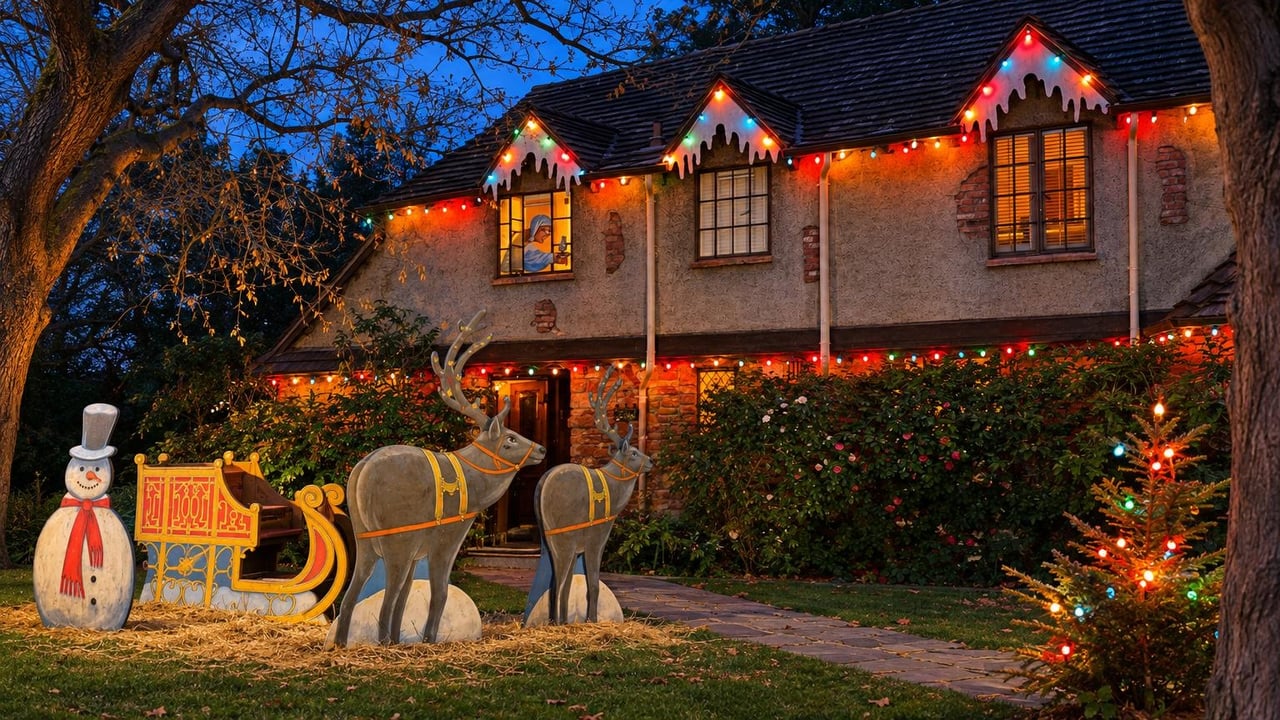
"As it is difficult to replace lighting units, and as it now will be impossible to do so for the near future, may we suggest that when a resident leases or sells his home he make some arrangement whereby the lessee or buyer can retain the use of the equipment." Judge Edward E. Hardy wrote that to his Fulton Street neighbors in 1943, as Peninsula Press reported in its account of the lane's history. He closed with the reason. "Only in this way with your help can we be assured of the continuance of our 'Christmas Fairyland Lane.'"
The street kept that custom. On Saturday, Dec. 12, the 1700 and 1800 blocks of Fulton Street become Christmas Tree Lane for the 86th time, and some of what you'll see has been handed from one owner of a house to the next. According to Peninsula Press, decorations and lights still pass between families on the street even though replacements are easy to buy now. Some of the figures in the yards have been on the street longer than the families who now put them out, and knowing a few of their histories makes a slow walk down those two blocks more fun.
The dates for 2026
The lane's organizers list this season as Saturday, Dec. 12 through Thursday, Dec. 31, with the lights on from 5 p.m. to 11 p.m. every night. The Almanac's Nov. 20 roundup of Peninsula holiday displays gives the same dates and hours and notes that it's free.
The lane always opens on a mid-December Saturday. It opened Dec. 11 in 2021, according to The Stanford Daily. It opened Dec. 16 in 2023, per Palo Alto Online. And it opened Dec. 14 in 2024, per the Palo Alto Daily Post. Every one of those seasons ran through Dec. 31. Dec. 12 is early in that range, so this year's lane has about three weeks of nights, including the whole week after Christmas.
The pipes came first
The lane's own site reprints a 1988 Palo Alto Times account of how it started. In 1940 Fulton Street was the last street in Palo Alto, and four residents came up with the idea over a bridge game at Hardy's home. That holiday season the men set pipes into the ground at even intervals in front of the houses on both blocks, ran electrical wire along the street and bought a tree for each pipe. The pipes were the tree stands.
The first version went by the name "Christmas Fairyland Lane" and had 54 trees with 15 lights apiece, according to the history on the organizers' site. The Daily Post's 2024 preview counted 72 small Douglas firs along the street, strung with multicolored lights. That's 18 more trees than the lane started with in 1940.
The 1940 setup helps explain Hardy's 1943 letter. The pipes and wiring ran in front of every house on both blocks, so each household's lights were one piece of a single shared row. In his letter Hardy wrote that lighting units were hard to replace and would soon be impossible to get. Asking sellers and landlords to leave the equipment with the house was his way of keeping each household's share of the row on the street.
A wartime blackout, and the year of red bows
In 1942 a wartime blackout left the lane without lights, according to Peninsula Press's history. The lights came back in 1943, even though trees and lights were hard to find. The Palo Alto Times called the street a "symbol of the Star of Peace" that year, which is also the year Hardy wrote his letter.
The street improvised again in 1973. President Richard Nixon asked Americans to skip holiday lights during the energy crisis. Fulton Street replaced the tree lights with shiny red bows and a silver star on top of each tree, and wrapped the lamp posts in red ribbon. Even without electricity, the street kept the row of trees.
Santa changed houses in 1974
Over the decades the lane's history has tracked individual figures as they moved along the street. Peninsula Press quoted the 1947 entry, which described "a spotlighted Santa with a pack on his back, about to descend the Hardy's Chimney" at 1830 Fulton. The same entry said the seven dwarfs usually seen climbing over 1850 Fulton were away that year because they "were badly in need of a paint job." In 1974 Santa moved from the Hardy family at 1830 Fulton to the Stone family at 1731 Fulton.
That move is Hardy's 1943 request carried out decades later, with a figure in place of a string of bulbs. The lane's best-known decorations have a record of where they stood on the street, and the record survives because the residents wrote it down.
Larry Christensen did much of that writing. He chaired the lane in 2010, when he told Palo Alto Online that "when Christmas Tree Lane lights up, the holiday season has arrived." In 2004 he and his son built a website to document the lane's history. Before that, Peninsula Press reported, the history lived in an album passed around each year at the neighbors' coffee. His own display is a Nutcracker scene. It began as one figure that a Palo Alto High School student built for him, based on a design he saw on a cocktail napkin, and it has since gained a ballerina and a seven-headed Mouse King. He told the outlet that when he first moved in, nearly 40 years earlier, most houses had no theme. "Everybody would decorate the trees in the mow strip and the city would come out and change the streetlights to red lamps."
What the street still does the same way every year
The details Christensen described in 2017 still hold. The Daily Post's 2024 preview reported that the City of Palo Alto swaps the street-lamp covers from white to red each season. The street trees still get old-style bulbs. Jim McDonnell told Peninsula Press that the small "Charlie Brown" trees get multicolored C9 lights, and "the white light goes on top." That year he sourced the trees from Oregon and bought 70 of them wholesale, splitting the order with a Willow Glen resident in San Jose who buys 700 for his own neighborhood.
Opening day starts in the morning. The Daily Post reported that residents gather on the Saturday the lane opens for coffee and brunch, sharing stories and pictures before the evening crowds arrive. In 2024 the effort was led by co-chairs Susan McDonnell and Tinwin Wang. "Decorating the street every year gives neighbors a chance to collaborate and create a special holiday treat for the entire community," they said in a statement.
Seeing it on foot or by car
You can drive or walk the lane, which wasn't the case in every recent year. In 2020 the Daily Post reported that the lane was drive-only because of COVID. Walking returned by 2021, and every season since has welcomed both.
The organizers' 2026 guidance for drivers is specific. Fulton Street runs both ways, and you can enter from Embarcadero Road or from Seale Avenue. Switch to parking lights instead of full headlights, drive slowly and stay in the car the whole time. Walkers are asked to watch for cars when crossing, since some families will be driving the lane.
The figures in the yards are hard to see from a moving car. In 2017 residents told Peninsula Press that the best way to take in the decorations is to park nearby and walk, and they pointed visitors to the corner of Tennyson and Fulton. On foot you can see which houses carry an older theme and which have started a new one, and you can find the white bulb on top of each tree.
The lane is just two blocks, so it fits easily into a December evening with another outing. Christmas Eve falls on a Thursday this year. If your family's plans include the Stanford Theatre's Dec. 24 showing of It's a Wonderful Life, our post on how those tickets go on sale covers the Dec. 5 sale at the box office. The lane stays lit nightly through Dec. 31, so the week between Christmas and New Year's gives you more evenings to go.
Fulton Street's custom of leaving the lights behind for the next owner is a good reminder that many Palo Alto houses come with a history worth asking about. If you'd like to talk through a home with that kind of history, or just compare notes on the city's oldest traditions, Christopher Mogensen is glad to help. Let's Connect.